USAWE Competitors
USAWE encourages safe and fair competitions throughout the country. We focus on horse welfare and providing a welcoming atmosphere for our competitors. Our organization is constantly striving to increase the number of competitions, reach diverse locations, and lower costs.
If you have not shown Working Equitation (WE) before, a review of the Getting Started Manual and the Rules and Dressage Tests will help you begin.
There are various levels of WE competition, and shows may offer multiple divisions within levels (Youth, Open, Amateur, and Young Horse for L1/L2 only). You may choose to compete at a level you feel comfortable at for as long as you like. Or, you may choose to continue your training and education and challenge yourself to move up the levels of increasing difficulty. You may self-advance at any time. However, choose wisely, there are requirements you must meet in order to move back down a level.
Working Equitation Competition Levels in the United States:
Level 1 – INTRODUCTORY
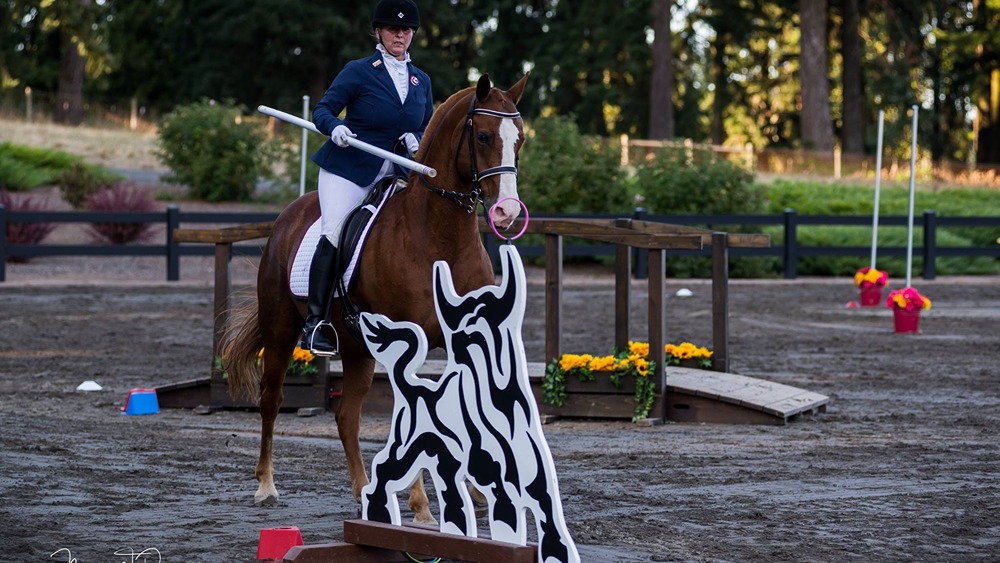
This is an introductory level designed for new horse-rider pairs, as well as young or green horses, or pairs who do not wish to canter. There is no Speed trial or Cattle trial at this level. Walk and trot (rising or sitting trot) are required in the Dressage and Ease of Handling (EOH) trials, and trot is required between obstacles in EOH. Two hands may be used on the reins. Riders at this level can opt to have a “reader” to read aloud their dressage test and/or EOH course. Competitors receive a 5-point penalty in lieu of disqualification for performance-related infractions.
Level 2 – NOVICE A
This level is designed for horse-rider pairs who are beginning their development in WE. This is the lowest level that includes a Speed trial. Canter is required in the Dressage trial and between obstacles in EOH. Changes of lead are through the trot. In EOH, obstacles must be trotted (rising or sitting trot), unless required or allowed to be walked. Riders at this level can opt to have a “reader” to read aloud their dressage test, EOH, and/or Speed course.
Level 3 – NOVICE B
This level requires more canter work than Level 2. Rising or sitting trot is allowed in the Dressage trial. Canter is required between obstacles in EOH, and canter is required at certain EOH obstacles such as the Retrieve Pole, Spear Ring, and Deposit Pole. Changes of lead through the trot are required. This is the first level that riders must memorize their dressage test and courses without a “reader.”
Level 4 – INTERMEDIATE A
This level is designed for horse-rider pairs progressing in their development. Sitting trot is required in the Dressage trial. In the canter work, simple changes of lead through the walk are required. In EOH, obstacles must be cantered, unless required or allowed to be walked. There is no trotting in EOH.
Level 5 – INTERMEDIATE B
Sitting trot is required in the Dressage trial. In Dressage and EOH, flying changes in canter are required.
Level 6 – ADVANCED
Sitting trot is required in the Dressage trial. Flying changes are required. This is the first level in which riders are required to ride with one hand only on the reins for all trials.
WAWE SENIOR RIDERS (MASTERS)
This level is judged by the regulations of the World Association for Working Equitation (WAWE). This is the highest level of the sport and is the level Adults aged older than 21 years must compete at in International WAWE competitions. Riders are required to ride with one hand only on the reins for all trials.
WAWE YOUNG RIDER
Riders turning maximum age of 21 years (between January 1 and December 31 within the respective year) can compete as Young Riders. Young Riders may also compete in L5 or L6 concurrently, but not in a single competition.
WAWE JUNIOR RIDER
Riders turning maximum age of 16 years (between January 1 and December 31 within the respective year) can compete as Juniors. Junior Riders may also compete in L5 or L6 concurrently, but not in the same competition.
Important Links
REQUIREMENTS
RESOURCES
JUDGING PERSPECTIVE